
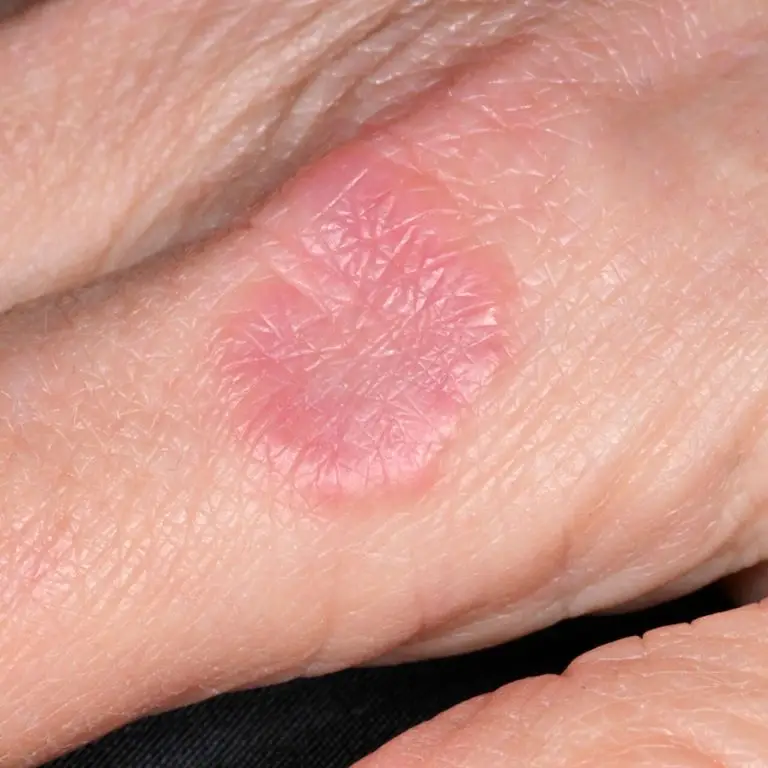
Granuloma annulare is a benign inflammatory skin condition that commonly causes rings or clusters of smooth bumps. It is not cancerous, contagious or a fungal infection.
Many cases clear without treatment, although resolution may take months or years. Treatment may be considered when the rash is widespread, persistent, symptomatic or cosmetically concerning.
The most common type causes:
The bumps frequently develop on the:
Some patients develop a more widespread form involving the trunk and limbs. Less common forms can cause bumps beneath the skin or areas that develop a central crust.
Most cases are painless. Some areas itch or feel tender.
No. Granuloma annulare is inflammatory, while ringworm is a contagious fungal infection.
Both can form ring-shaped patches, but ringworm often has a raised, scaly edge and may itch. Granuloma annulare generally consists of smooth bumps without scale.
Using antifungal medication will not treat granuloma annulare.
The exact cause is unknown. It appears to be a reaction occurring within the skin.
In some patients, it develops after:
Often, no trigger can be identified.
Widespread granuloma annulare has occasionally been associated with other health conditions, but most patients are otherwise healthy.
A dermatologist may recognize the condition by examining the skin. Because it can resemble ringworm, sarcoidosis, eczema and other conditions, a biopsy may be recommended.
During a biopsy, a small sample is removed and examined under a microscope.
Additional testing is not routinely necessary but may be considered for widespread, recurrent or unusual cases.
Many patients do not require treatment because the rash often clears by itself.
When treatment is desired, options may include:
Even after successful treatment, granuloma annulare can return.
Ring-shaped rashes do not all have the same cause. The Dermatology Clinic can distinguish granuloma annulare from fungal infection and other skin conditions and explain whether treatment or observation is appropriate. Contact us today to get scheduled.
We would love to get started on a solution that perfectly fits your needs.