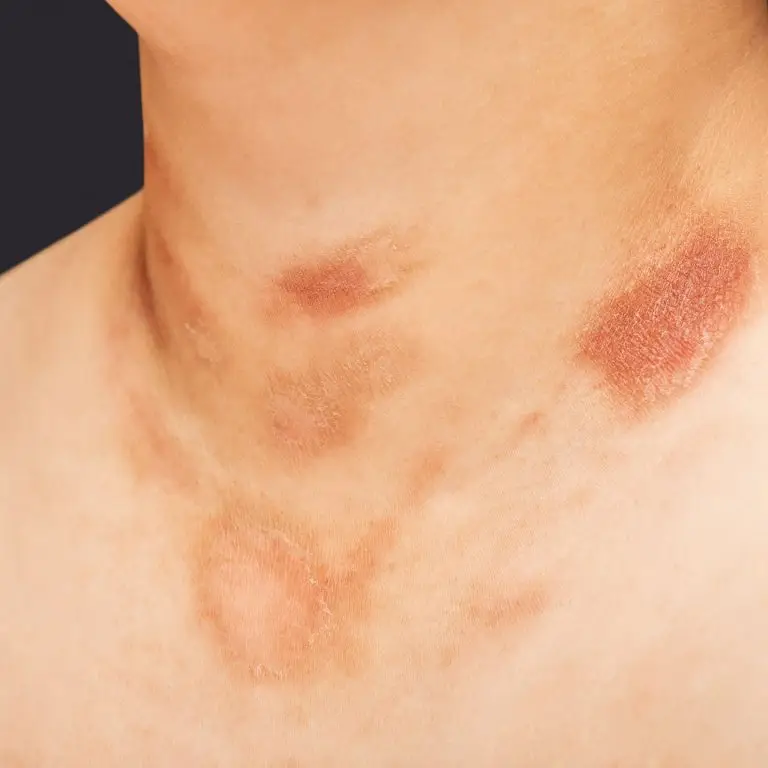
Pityriasis rosea is a temporary rash that often begins with one larger scaly patch, followed by multiple smaller patches. It is generally harmless and usually clears without leaving scars.
Because pityriasis rosea can resemble ringworm, eczema, psoriasis, a medication reaction or another illness, professional diagnosis may be important.
The rash often begins with a single oval patch called a herald patch. It may develop on the chest, back, abdomen or another area.
Several days to two weeks later, smaller patches may appear across the trunk, upper arms or thighs. These patches often follow the natural lines of the skin and can create a pattern resembling drooping branches.
Depending on skin tone, the rash may appear:
The patches usually have a fine, wrinkled scale near their edges.
Some patients have no symptoms other than the rash. Others develop mild to severe itching.
Before the rash appears, a patient may briefly experience:
Not everyone develops a herald patch or the classic distribution.
The exact cause remains uncertain. Research suggests that reactivation of certain viruses may be involved, but pityriasis rosea is not generally considered contagious.
You do not need to avoid school, work or close contact solely because of this diagnosis.
The rash is not caused by fungus, and over-the-counter ringworm medication will not clear it.
A dermatologist may diagnose the condition by examining the pattern and scale.
Testing may be performed when the rash is unusual. A skin scraping can exclude fungus, while blood testing may help rule out another illness. A biopsy is occasionally needed.
Tell your provider about all medications and supplements because some drug reactions can resemble pityriasis rosea.
The rash generally clears on its own, often within several weeks, although some cases last longer.
Treatment may be recommended for discomfort and can include:
Cool or lukewarm bathing and loose clothing may reduce itching.
Patients who are pregnant or may be pregnant should inform their healthcare provider, particularly when the rash develops early in pregnancy.
Pityriasis rosea can be difficult to distinguish from fungal infection and other rashes. The Dermatology Clinic can confirm the cause and recommend treatment when itching or widespread inflammation becomes uncomfortable. Contact us today to get scheduled.
We would love to get started on a solution that perfectly fits your needs.